
Kaggle-House Prices - Advanced Regression Techniques
House price regression Techniques
-
Goal: We predict the final price of each home based on the given features. -
Metric:Root-Mean-Squared-Error (RMSE)between the logarithm of the predicted value and the logarithm of the observed sales price. -
-
79 features describing (almost) every aspect of residential homes in Ames, Iowa, y=salePrice
-
import pandas as pd
import numpy as np
import seaborn as sns
import matplotlib.pyplot as plt
%matplotlib inline

from sklearn.linear_model import LinearRegression, Ridge, Lasso
from sklearn.model_selection import train_test_split
from sklearn.metrics import mean_squared_error

import warnings
warnings.filterwarnings('ignore')
Dataset
house_df_org = pd.read_csv('input/house_price.csv')
house_df = house_df_org.copy()
df.head(3)
| Id | MSSubClass | MSZoning | LotFrontage | LotArea | Street | Alley | LotShape | LandContour | Utilities | ... | PoolArea | PoolQC | Fence | MiscFeature | MiscVal | MoSold | YrSold | SaleType | SaleCondition | SalePrice | |
|---|---|---|---|---|---|---|---|---|---|---|---|---|---|---|---|---|---|---|---|---|---|
| 0 | 1 | 60 | RL | 65.0 | 8450 | Pave | NaN | Reg | Lvl | AllPub | ... | 0 | NaN | NaN | NaN | 0 | 2 | 2008 | WD | Normal | 208500 |
| 1 | 2 | 20 | RL | 80.0 | 9600 | Pave | NaN | Reg | Lvl | AllPub | ... | 0 | NaN | NaN | NaN | 0 | 5 | 2007 | WD | Normal | 181500 |
| 2 | 3 | 60 | RL | 68.0 | 11250 | Pave | NaN | IR1 | Lvl | AllPub | ... | 0 | NaN | NaN | NaN | 0 | 9 | 2008 | WD | Normal | 223500 |
3 rows × 81 columns
house_df.shape
(1460, 81)
#df.info()
house_df.describe()
| Id | MSSubClass | LotFrontage | LotArea | OverallQual | OverallCond | YearBuilt | YearRemodAdd | MasVnrArea | BsmtFinSF1 | ... | WoodDeckSF | OpenPorchSF | EnclosedPorch | 3SsnPorch | ScreenPorch | PoolArea | MiscVal | MoSold | YrSold | SalePrice | |
|---|---|---|---|---|---|---|---|---|---|---|---|---|---|---|---|---|---|---|---|---|---|
| count | 1460.000000 | 1460.000000 | 1201.000000 | 1460.000000 | 1460.000000 | 1460.000000 | 1460.000000 | 1460.000000 | 1452.000000 | 1460.000000 | ... | 1460.000000 | 1460.000000 | 1460.000000 | 1460.000000 | 1460.000000 | 1460.000000 | 1460.000000 | 1460.000000 | 1460.000000 | 1460.000000 |
| mean | 730.500000 | 56.897260 | 70.049958 | 10516.828082 | 6.099315 | 5.575342 | 1971.267808 | 1984.865753 | 103.685262 | 443.639726 | ... | 94.244521 | 46.660274 | 21.954110 | 3.409589 | 15.060959 | 2.758904 | 43.489041 | 6.321918 | 2007.815753 | 180921.195890 |
| std | 421.610009 | 42.300571 | 24.284752 | 9981.264932 | 1.382997 | 1.112799 | 30.202904 | 20.645407 | 181.066207 | 456.098091 | ... | 125.338794 | 66.256028 | 61.119149 | 29.317331 | 55.757415 | 40.177307 | 496.123024 | 2.703626 | 1.328095 | 79442.502883 |
| min | 1.000000 | 20.000000 | 21.000000 | 1300.000000 | 1.000000 | 1.000000 | 1872.000000 | 1950.000000 | 0.000000 | 0.000000 | ... | 0.000000 | 0.000000 | 0.000000 | 0.000000 | 0.000000 | 0.000000 | 0.000000 | 1.000000 | 2006.000000 | 34900.000000 |
| 25% | 365.750000 | 20.000000 | 59.000000 | 7553.500000 | 5.000000 | 5.000000 | 1954.000000 | 1967.000000 | 0.000000 | 0.000000 | ... | 0.000000 | 0.000000 | 0.000000 | 0.000000 | 0.000000 | 0.000000 | 0.000000 | 5.000000 | 2007.000000 | 129975.000000 |
| 50% | 730.500000 | 50.000000 | 69.000000 | 9478.500000 | 6.000000 | 5.000000 | 1973.000000 | 1994.000000 | 0.000000 | 383.500000 | ... | 0.000000 | 25.000000 | 0.000000 | 0.000000 | 0.000000 | 0.000000 | 0.000000 | 6.000000 | 2008.000000 | 163000.000000 |
| 75% | 1095.250000 | 70.000000 | 80.000000 | 11601.500000 | 7.000000 | 6.000000 | 2000.000000 | 2004.000000 | 166.000000 | 712.250000 | ... | 168.000000 | 68.000000 | 0.000000 | 0.000000 | 0.000000 | 0.000000 | 0.000000 | 8.000000 | 2009.000000 | 214000.000000 |
| max | 1460.000000 | 190.000000 | 313.000000 | 215245.000000 | 10.000000 | 9.000000 | 2010.000000 | 2010.000000 | 1600.000000 | 5644.000000 | ... | 857.000000 | 547.000000 | 552.000000 | 508.000000 | 480.000000 | 738.000000 | 15500.000000 | 12.000000 | 2010.000000 | 755000.000000 |
8 rows × 38 columns
Null data check
house_df.isnull().sum()[house_df.isnull().sum()>0].sort_values(ascending=False)
PoolQC          1453
MiscFeature     1406
Alley           1369
Fence           1179
FireplaceQu      690
LotFrontage      259
GarageType        81
GarageYrBlt       81
GarageFinish      81
GarageQual        81
GarageCond        81
BsmtExposure      38
BsmtFinType2      38
BsmtFinType1      37
BsmtCond          37
BsmtQual          37
MasVnrArea         8
MasVnrType         8
Electrical         1
dtype: int64
# Drop the features containing many NaNs.
house_df.drop(['PoolQC', 'MiscFeature', 'Alley', 'Fence','FireplaceQu', 'Id'], axis=1, inplace=True)

house_df.fillna(house_df.mean(), inplace=True)
# Features type
house_df.dtypes.value_counts()
object     38
int64      34
float64     3
dtype: int64
The distribution of Target Label
plt.title('Original Sale Price Histogram')
sns.distplot(house_df['SalePrice']) # skewed
<AxesSubplot:title={'center':'Original Sale Price Histogram'}, xlabel='SalePrice', ylabel='Density'>

plt.title('Log transformed Sale Price Histogram')
log_SalePrice =np.log1p(house_df['SalePrice'])
sns.distplot(log_SalePrice)
<AxesSubplot:title={'center':'Log Transformed Sale Price Histogram'}, xlabel='SalePrice', ylabel='Density'>

house_df['log_SalePrice'] = log_SalePrice
house_df.drop(['SalePrice'], axis=1, inplace=True)
nulls = house_df.isnull().sum()[house_df.isnull().sum()>0]
house_df[nulls.index].dtypes
MasVnrType      object
BsmtQual        object
BsmtCond        object
BsmtExposure    object
BsmtFinType1    object
BsmtFinType2    object
Electrical      object
GarageType      object
GarageFinish    object
GarageQual      object
GarageCond      object
dtype: object
Feature Engineering/ Model Learning
One-hot encoding
# One-hot encoding for object features with null values
house_df_ohe = pd.get_dummies(house_df)
print('Before One-hot:', house_df.shape)
print('After One-hot:', house_df_ohe.shape)
print(house_df_ohe.isnull().sum()[house_df_ohe.isnull().sum()>0])
Before One-hot: (1460, 75)
After One-hot: (1460, 271)
Series([], dtype: int64)
Split the training set and test set
y_target = house_df_ohe['log_SalePrice']
X_features = house_df_ohe.drop('log_SalePrice', axis=1, inplace=False)
X_train, X_test, y_train, y_test = train_test_split(X_features, y_target, test_size=0.2, random_state=156)
Linear Regression Model Learning/Prediction/Evaluation
def get_rmse(model):
    model.fit(X_train, y_train)
    pred = model.predict(X_test)
    rmse = np.sqrt(mean_squared_error(y_test, pred)) #Because y is already logged.
    print('RMSE of',model.__class__.__name__, np.round(rmse,3))
    return rmse

def get_rmses(models):
    rmses=[]
    for model in models:
        rmse = get_rmse(model)
        rmses.append(rmse)
lr_reg = LinearRegression()
lr_reg.fit(X_train, y_train)

ridge_reg = Ridge()
ridge_reg.fit(X_train, y_train)

lasso_reg = Lasso()
lasso_reg.fit(X_train, y_train)

models = [lr_reg, ridge_reg, lasso_reg]
get_rmses(models)
RMSE of LinearRegression 0.132
RMSE of Ridge 0.128
RMSE of Lasso 0.176
Coefficient Visualization
def get_top_bottom_coef(model):
    coef = pd.Series(model.coef_, index=X_features.columns)
    coef_high = coef.sort_values(ascending=False).head(10)
    coef_low = coef.sort_values(ascending=False).tail(10)
    return coef_high, coef_low
def visualize_coefficient(models):

    fig, axs = plt.subplots(figsize=(24,10),nrows=1, ncols=3)
    fig.tight_layout()

    for i_num, model in enumerate(models):

        coef_high, coef_low = get_top_bottom_coef(model) # The top 10 and the bottom 10 coefficients.
        coef_concat = pd.concat( [coef_high , coef_low] )
        axs[i_num].set_title(model.__class__.__name__+' Coeffiecents', size=25)
        axs[i_num].tick_params(axis="y",direction="in", pad=-120)
        for label in (axs[i_num].get_xticklabels() + axs[i_num].get_yticklabels()):
            label.set_fontsize(22)
        sns.barplot(x=coef_concat.values, y=coef_concat.index , ax=axs[i_num])
#lr_reg, ridge_reg, lasso_reg Model

models = [lr_reg, ridge_reg, lasso_reg]
visualize_coefficient(models)

Cross Validation
from sklearn.model_selection import cross_val_score

def get_avg_rmse_cv(models):
    for model in models:
        rmse_list = np.sqrt(-cross_val_score(model, X_features, y_target,
                                             scoring="neg_mean_squared_error", cv = 5))
        rmse_avg = np.mean(rmse_list)
        print('\n{0} The list of RMSEs: {1}'.format( model.__class__.__name__, np.round(rmse_list, 3)))
        print('{0} mean RMSE: {1}'.format( model.__class__.__name__, np.round(rmse_avg, 3)))

models = [lr_reg, ridge_reg, lasso_reg]
get_avg_rmse_cv(models)
LinearRegression The list of RMSEs: [0.135 0.165 0.168 0.111 0.198]
LinearRegression mean RMSE: 0.155

Ridge The list of RMSEs: [0.115 0.148 0.13  0.118 0.186]
Ridge mean RMSE: 0.139

Lasso The list of RMSEs: [0.11  0.15  0.125 0.114 0.193]
Lasso mean RMSE: 0.139
Hyperparameter tuning
from sklearn.model_selection import GridSearchCV

def print_best_params(model, params):
    grid_model = GridSearchCV(model, param_grid=params,
                              scoring='neg_mean_squared_error', cv=5)
    grid_model.fit(X_features, y_target)
    rmse = np.sqrt(-1* grid_model.best_score_)
    print('{0} RMSE on the best parameters: {1}, The best alpha:{2}'.format(model.__class__.__name__,
                                        np.round(rmse, 4), grid_model.best_params_))
    return grid_model.best_estimator_

ridge_params = { 'alpha':[0.05, 0.1, 1, 5, 8, 10, 12, 15, 20] }
lasso_params = { 'alpha':[0.001, 0.005, 0.008, 0.05, 0.03, 0.1, 0.5, 1,5, 10] }
best_rige = print_best_params(ridge_reg, ridge_params)
best_lasso = print_best_params(lasso_reg, lasso_params)
Ridge RMSE on the best parameters: 0.1418, The best alpha:{'alpha': 12}
Lasso RMSE on the best parameters: 0.142, The best alpha:{'alpha': 0.001}
lr_reg = LinearRegression()
lr_reg.fit(X_train, y_train)
ridge_reg = Ridge(alpha=12)
ridge_reg.fit(X_train, y_train)
lasso_reg = Lasso(alpha=0.001)
lasso_reg.fit(X_train, y_train)

models = [lr_reg, ridge_reg, lasso_reg]
get_rmses(models)

models = [lr_reg, ridge_reg, lasso_reg]
visualize_coefficient(models)
RMSE of LinearRegression 0.132
RMSE of Ridge 0.124
RMSE of Lasso 0.12
Transform very skewed dataset
from scipy.stats import skew

# Select int/float, not object.
features_index = house_df.dtypes[house_df.dtypes != 'object'].index
skew_features = house_df[features_index].apply(lambda x : skew(x))

# Skew > 1
skew_features_top = skew_features[skew_features > 1]
print(skew_features_top.sort_values(ascending=False))
PoolArea         14.348342
3SsnPorch         7.727026
LowQualFinSF      7.452650
MiscVal           5.165390
BsmtHalfBath      3.929022
KitchenAbvGr      3.865437
ScreenPorch       3.147171
BsmtFinSF2        2.521100
EnclosedPorch     2.110104
dtype: float64
house_df[skew_features_top.index] = np.log1p(house_df[skew_features_top.index])
house_df_ohe = pd.get_dummies(house_df)
y_target = house_df_ohe['log_SalePrice']
X_features = house_df_ohe.drop('log_SalePrice',axis=1, inplace=False)
X_train, X_test, y_train, y_test = train_test_split(X_features, y_target, test_size=0.2, random_state=156)


ridge_params = { 'alpha':[0.05, 0.1, 1, 5, 8, 10, 12, 15, 20] }
lasso_params = { 'alpha':[0.001, 0.005, 0.008, 0.05, 0.03, 0.1, 0.5, 1,5, 10] }
best_ridge = print_best_params(ridge_reg, ridge_params)
best_lasso = print_best_params(lasso_reg, lasso_params)
Ridge RMSE on the best parameters: 0.1276, The best alpha:{'alpha': 10}
Lasso RMSE on the best parameters: 0.1251, The best alpha:{'alpha': 0.001}
lr_reg = LinearRegression()
lr_reg.fit(X_train, y_train)
ridge_reg = Ridge(alpha=10)
ridge_reg.fit(X_train, y_train)
lasso_reg = Lasso(alpha=0.001)
lasso_reg.fit(X_train, y_train)


models = [lr_reg, ridge_reg, lasso_reg]
get_rmses(models)

models = [lr_reg, ridge_reg, lasso_reg]
visualize_coefficient(models)
RMSE of LinearRegression 0.129
RMSE of Ridge 0.121
RMSE of Lasso 0.117

Outlier Removal
plt.scatter(x = house_df_org['GrLivArea'], y = house_df_org['SalePrice'])
plt.ylabel('SalePrice', fontsize=15)
plt.xlabel('GrLivArea', fontsize=15)
plt.show()

cond1 = house_df_ohe['GrLivArea'] > np.log1p(4000) #Since they have been logged, the condition has to be logged.
cond2 = house_df_ohe['log_SalePrice'] < np.log1p(500000)
outlier_index = house_df_ohe[cond1 & cond2].index

print('Outlier index :', outlier_index.values)
print('house_df_ohe shape before outlier removal:', house_df_ohe.shape)

# Delet outliers.
house_df_ohe.drop(outlier_index , axis=0, inplace=True)
print('house_df_ohe shape after outlier removal:', house_df_ohe.shape)
Outlier index : [ 523 1298]
house_df_ohe shape before outlier removal: (1460, 271)
house_df_ohe shape after outlier removal: (1458, 271)
y_target = house_df_ohe['log_SalePrice']
X_features = house_df_ohe.drop('log_SalePrice',axis=1, inplace=False)
X_train, X_test, y_train, y_test = train_test_split(X_features, y_target, test_size=0.2, random_state=156)

ridge_params = { 'alpha':[0.05, 0.1, 1, 5, 8, 10, 12, 15, 20] }
lasso_params = { 'alpha':[0.001, 0.005, 0.008, 0.05, 0.03, 0.1, 0.5, 1,5, 10] }
best_ridge = print_best_params(ridge_reg, ridge_params)
best_lasso = print_best_params(lasso_reg, lasso_params)
Ridge RMSE on the best parameters: 0.1125, The best alpha:{'alpha': 8}
Lasso RMSE on the best parameters: 0.1122, The best alpha:{'alpha': 0.001}
lr_reg = LinearRegression()
lr_reg.fit(X_train, y_train)
ridge_reg = Ridge(alpha=8)
ridge_reg.fit(X_train, y_train)
lasso_reg = Lasso(alpha=0.001)
lasso_reg.fit(X_train, y_train)

# RMSE on each model
models = [lr_reg, ridge_reg, lasso_reg]
get_rmses(models)

# Visualization of important coefficients
models = [lr_reg, ridge_reg, lasso_reg]
visualize_coefficient(models)
RMSE of LinearRegression 0.129
RMSE of Ridge 0.103
RMSE of Lasso 0.1

Tree-based Regression Learning/Prediction/Evaluation
from xgboost import XGBRegressor

xgb_params = {'n_estimators':[1000]}
xgb_reg = XGBRegressor(n_estimators=1000, learning_rate=0.05,
                       colsample_bytree=0.5, subsample=0.8)
best_xgb = print_best_params(xgb_reg, xgb_params)
XGBRegressor RMSE on the best parameters: 0.1198, The best alpha:{'n_estimators': 1000}
from lightgbm import LGBMRegressor

lgbm_params = {'n_estimators':[1000]}
lgbm_reg = LGBMRegressor(n_estimators=1000, learning_rate=0.05, num_leaves=4,
                         subsample=0.6, colsample_bytree=0.4, reg_lambda=10, n_jobs=-1)
best_lgbm = print_best_params(lgbm_reg, lgbm_params)
LGBMRegressor RMSE on the best parameters: 0.1163, The best alpha:{'n_estimators': 1000}
def get_top_features(model):
    ftr_importances_values = model.feature_importances_
    ftr_importances = pd.Series(ftr_importances_values, index=X_features.columns  )
    ftr_top20 = ftr_importances.sort_values(ascending=False)[:20]
    return ftr_top20

def visualize_ftr_importances(models):
    fig, axs = plt.subplots(figsize=(24,10),nrows=1, ncols=2)
    fig.tight_layout()
    for i_num, model in enumerate(models):
        ftr_top20 = get_top_features(model)
        axs[i_num].set_title(model.__class__.__name__+' Feature Importances', size=25)

        for label in (axs[i_num].get_xticklabels() + axs[i_num].get_yticklabels()):
            label.set_fontsize(22)
        sns.barplot(x=ftr_top20.values, y=ftr_top20.index , ax=axs[i_num])


models = [best_xgb, best_lgbm]
visualize_ftr_importances(models)

Stacking
Weighted Averaging
def get_rmse_pred(preds):
    for key in preds.keys():
        pred_value = preds[key]
        mse = mean_squared_error(y_test , pred_value)
        rmse = np.sqrt(mse)
        print('RMSE of {0}: {1}'.format(key, rmse))

# Training each model
ridge_reg = Ridge(alpha=8)
ridge_reg.fit(X_train, y_train)
lasso_reg = Lasso(alpha=0.001)
lasso_reg.fit(X_train, y_train)

# Prediction
ridge_pred = ridge_reg.predict(X_test)
lasso_pred = lasso_reg.predict(X_test)

# Weighted average of models
pred = 0.4 * ridge_pred + 0.6 * lasso_pred
preds = {'Mixed': pred,
         'Ridge': ridge_pred,
         'Lasso': lasso_pred}

#Final mixed model based on ridge and lasso
get_rmse_pred(preds)
RMSE of Mixed: 0.09970842737250571
RMSE of Ridge: 0.10313299412082655
RMSE of Lasso: 0.09991843167945542
xgb_reg = XGBRegressor(n_estimators=1000, learning_rate=0.05,
                       colsample_bytree=0.5, subsample=0.8)
lgbm_reg = LGBMRegressor(n_estimators=1000, learning_rate=0.05, num_leaves=4,
                         subsample=0.6, colsample_bytree=0.4, reg_lambda=10, n_jobs=-1)
xgb_reg.fit(X_train, y_train)
lgbm_reg.fit(X_train, y_train)
xgb_pred = xgb_reg.predict(X_test)
lgbm_pred = lgbm_reg.predict(X_test)

pred = 0.5 * xgb_pred + 0.5 * lgbm_pred
preds = {'Mixed': pred,
         'XGBM': xgb_pred,
         'LGBM': lgbm_pred}

get_rmse_pred(preds)
RMSE of Mixed: 0.10277689340617208
RMSE of XGBM: 0.10946473825650248
RMSE of LGBM: 0.10382510019327311
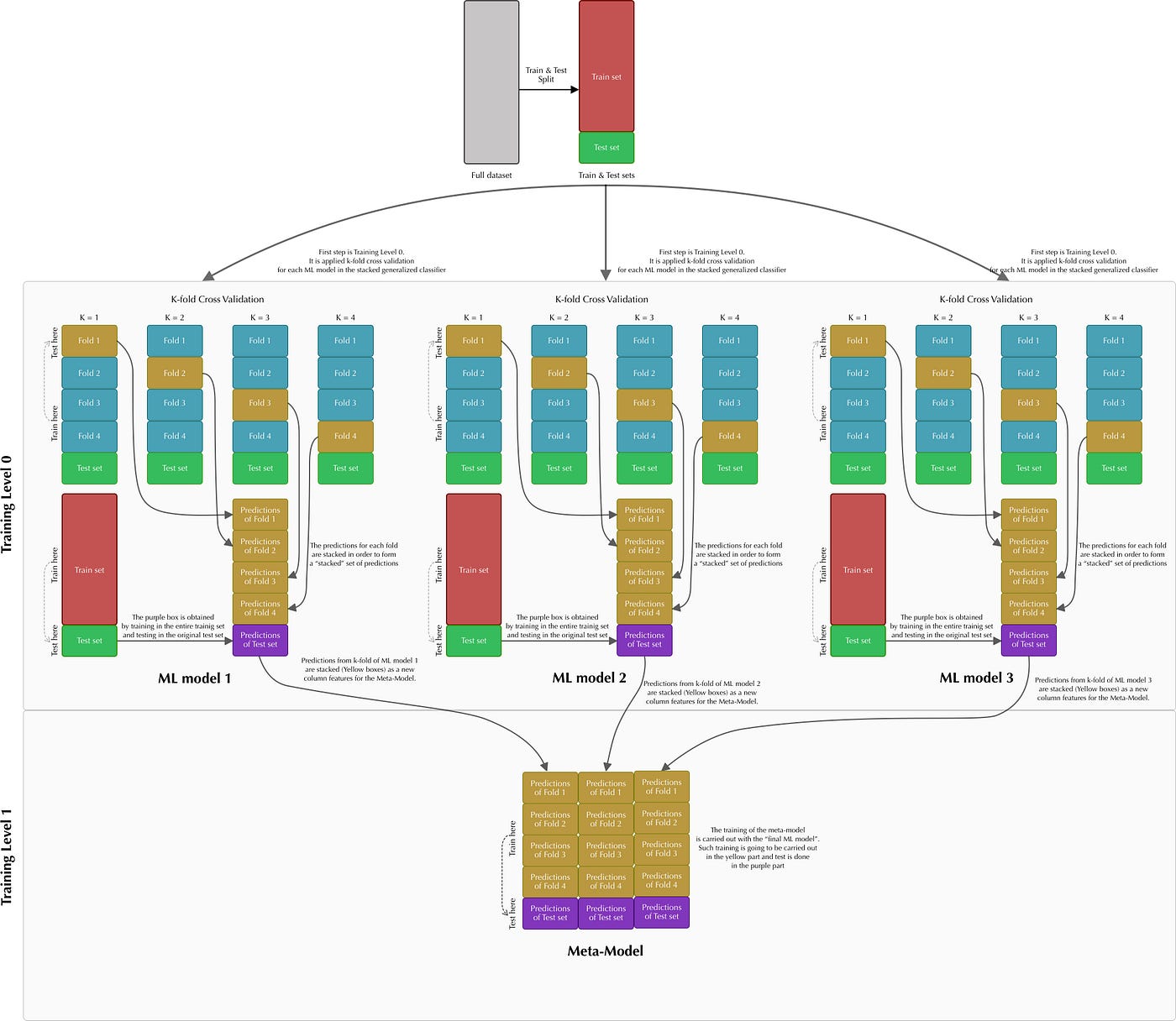
Meta-classifier
from sklearn.model_selection import KFold
from sklearn.metrics import mean_absolute_error


def get_stacking_base_datasets(model, X_train_n, y_train_n, X_test_n, n_folds ):

    kf = KFold(n_splits=n_folds, shuffle=True, random_state=0)

    train_fold_pred = np.zeros((X_train_n.shape[0] ,1 ))
    test_pred = np.zeros((X_test_n.shape[0],n_folds))
    print(model.__class__.__name__ , ' Start model')

    for folder_counter , (train_index, valid_index) in enumerate(kf.split(X_train_n)):

        print('\t fold-set: ',folder_counter,' Start ')
        X_tr = X_train_n[train_index]
        y_tr = y_train_n[train_index]
        X_te = X_train_n[valid_index]


        model.fit(X_tr , y_tr)

        train_fold_pred[valid_index, :] = model.predict(X_te).reshape(-1,1)

        test_pred[:, folder_counter] = model.predict(X_test_n)


    test_pred_mean = np.mean(test_pred, axis=1).reshape(-1,1)


    return train_fold_pred , test_pred_mean
# get_stacking_base_datasets( ) uses numpy ndarray.
X_train_n = X_train.values
X_test_n = X_test.values
y_train_n = y_train.values

# Training/ test data based on each base model.
ridge_train, ridge_test = get_stacking_base_datasets(ridge_reg, X_train_n, y_train_n, X_test_n, 5)
lasso_train, lasso_test = get_stacking_base_datasets(lasso_reg, X_train_n, y_train_n, X_test_n, 5)
xgb_train, xgb_test = get_stacking_base_datasets(xgb_reg, X_train_n, y_train_n, X_test_n, 5)
lgbm_train, lgbm_test = get_stacking_base_datasets(lgbm_reg, X_train_n, y_train_n, X_test_n, 5)
Ridge  Start model
	 fold-set:  0  Start
	 fold-set:  1  Start
	 fold-set:  2  Start
	 fold-set:  3  Start
	 fold-set:  4  Start
Lasso  Start model
	 fold-set:  0  Start
	 fold-set:  1  Start
	 fold-set:  2  Start
	 fold-set:  3  Start
	 fold-set:  4  Start
XGBRegressor  Start model
	 fold-set:  0  Start
	 fold-set:  1  Start
	 fold-set:  2  Start
	 fold-set:  3  Start
	 fold-set:  4  Start
LGBMRegressor  Start model
	 fold-set:  0  Start
	 fold-set:  1  Start
	 fold-set:  2  Start
	 fold-set:  3  Start
	 fold-set:  4  Start
# Stacking training/ test data based on each base model
Stack_final_X_train = np.concatenate((ridge_train, lasso_train,
                                      xgb_train, lgbm_train), axis=1)
Stack_final_X_test = np.concatenate((ridge_test, lasso_test,
                                     xgb_test, lgbm_test), axis=1)

# Final meta model = Lasso model.
meta_model_lasso = Lasso(alpha=0.0005)

# Evaluation of RMSE
meta_model_lasso.fit(Stack_final_X_train, y_train)
final = meta_model_lasso.predict(Stack_final_X_test)
mse = mean_squared_error(y_test , final)
rmse = np.sqrt(mse)
print('RMSE of stacking regression model:', rmse)
RMSE of stacking regression model: 0.09827602546454259
Leave a comment